
Latest Articles

Uncategorized

The Financial Mirror You’ve Been Avoiding: A “No Shame, No Blame” Guide to Facing Your Money Reality

03 Mar 22 2026_NoShame

There’s a concept in Vicki Robin’s landmark personal finance book, Your Money or Your Life, that stopped our entire team in its tracks as we are currently in the last chapters of reading this book together.

Robin calls it the “No Shame, No Blame” approach to looking at your personal financial position. The idea is deceptively simple: before you can improve your financial life, you have to be willing to look honestly at where you actually are right now—not where you wish you were, not where you think you should be, but where the numbers actually say you are.

It sounds obvious. But in practice, it’s one of the hardest things most people ever do.


The exercise that changes everything

Here’s the challenge I shared a while ago, and one I strongly encourage you to do if you haven’t already:

Pull your tax returns for the last 10 years and add up:

  • Every dollar of total income you earned (line 15000 of your return)
  • Every dollar of taxes you paid (line 43500), plus payroll taxes, HST/GST, property taxes, and other taxes
  • The dollar amount you actually kept

Then calculate your personal net worth today: add up all your assets (home equity, investments, RRSPs, TFSAs, savings, business value), subtract all your liabilities (mortgage, car loans, lines of credit, credit card balances, student debt), and get a single number.

What you’re left with is your financial mirror.

As of early 2026, Canadian household credit market debt has surpassed 3.2 trillion dollars, ending 2025 up 4.4% year-over-year. Total household debt across all consumer credit products hit a record 2.6 trillion dollars in Q4 2025. These are not just statistics—they represent millions of Canadians who, like many of us at some point, earned income for years and have very little net wealth to show for it.

You may be one of them. I was.


Confronting the results: what Vicki Robin got right

When I first did this exercise myself, the results were uncomfortable. Not catastrophic—but certainly not what I had hoped for. Years of income, years of effort, and a net worth that told a quiet but honest story about the financial decisions I had made along the way.

Robin’s insight is this: the only productive way to respond to that discomfort is with complete honesty, and zero judgment. Not shame. Not blame. Not denial. Just clear-eyed acknowledgment of the facts before you.​

Dr. Henry Cloud, in his book Integrity, puts it this way:

“Reality is always your friend.”

He goes on to say: “For us to get real results in the real world, we must be in touch with what is—not what we wish things were, or think things should be, or are led by others to believe they are.”

That quote hits differently when you’re sitting in front of your own financial data.

The point is not to feel bad. The point is that the moment you stop avoiding the truth of your financial position, you give yourself the one thing that makes change possible: an honest starting point.​


Why this is particularly hard for some of us

Confronting your financial reality is emotionally charged for everyone—but in my experience working with clients across Canada, it tends to be especially difficult for high earners.

When you’ve worked hard, built a business, and have an impressive lifestyle, a negative or mediocre net worth feels like a verdict on your entire effort. It isn’t. It’s simply feedback.

Robin’s framework reminds us that the goal isn’t to feel guilty about the income you’ve already spent. The goal is to learn enough from that data that when the next two million dollars flows through your life, you keep it.​


What “No Shame, No Blame” actually looks like in practice

Here’s a simple, structured way to do this exercise:

Step 1: Calculate your lifetime earnings
Go back as far as your tax records allow. Add up your total income from every return. This number will likely surprise you.

Step 2: Calculate what you kept
Add up every tax dollar you paid—income tax, payroll tax, HST, property tax. Subtract that from your lifetime earnings. Then subtract your current debt. What’s left is your real financial output.

Step 3: Calculate your net worth today
Assets minus liabilities. One number. No rounding up. No leaving out the credit card balance.

Step 4: Sit with what you find—without judgment
Accept the results as data, not as a verdict. Acknowledge where you’ve made costly decisions. Recognize what you’ve genuinely achieved. Be grateful for the opportunities ahead of you.

Step 5: Decide what you’re going to do differently
This is where the exercise earns its value. Now that you can see the gap between what you earned and what you kept, you can actually plan to close it.


Where taxes fit into all of this

As a CPA, I’ll be direct: for most Canadians with a decent income, taxes are the single largest erosion of wealth between what you earn and what you keep.

Yet most people file their return once a year, get a refund (or a bill), and move on—without ever asking:

  • What is my actual average tax rate?
  • What is my marginal rate?
  • Why did I get a refund—and is that actually a good thing?
  • What can I legally do this year to reduce what I’ll owe next year?

If you don’t have clear answers to those questions, you’re leaving real money behind every single year—money that compounds over time into a much larger gap between what you earned and what you built.

This is exactly what my team and I help clients address. Not just filing your return accurately, but understanding your numbers deeply enough to make better financial decisions going forward.


Your next step: face the mirror, then make a plan

This tax season, I want to challenge you to do more than just file your return and move on.

Do the exercise. Pull the numbers. Calculate your net worth. Sit with the results—no shame, no blame—and then ask honestly: Is the gap between what I earn and what I keep acceptable to me?

If it’s not, this is exactly the right moment to change it.

As a CPA, I work with individuals, professionals, and business owners across Canada to:

  • Review their tax returns with an insight-first lens (not just compliance)
  • Identify legal tax reduction strategies they’re currently missing
  • Build a clear picture of their current financial position and a plan to improve it

You’ve already done the hard work of earning the income. Let’s make sure you actually keep more of it.

Book a call with me here and let’s have an honest, no-shame, no-blame conversation about your tax situation and what’s possible for the year ahead.

read more
Tax Planning

Capital gains in plain language

03 Mar 15 2026_Capitalgains

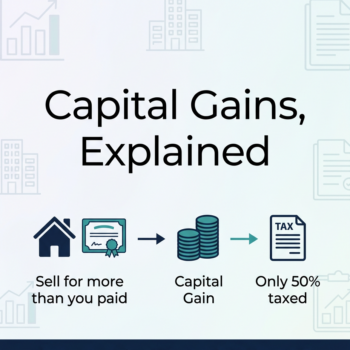
A capital gain happens when you sell (or are considered to have sold) a capital asset for more than what it cost you, plus selling costs.​

Common capital assets include:​

  • Non‑registered investments (stocks, ETFs, mutual funds, bonds)
  • Rental properties and cottages
  • Shares in a private corporation
  • Certain business assets (goodwill, trademarks, etc.)

If you sell for less than it cost you, you have a capital loss.​

Your principal residence is a special case: in many situations, you can claim the principal residence exemption so that the gain is not taxable.​


How much tax do you pay on capital gains?

For individuals, you are not taxed on the full gain.

  • Right now, generally 50% of your net capital gain is included in your income (the “inclusion rate”).
  • That taxable amount is reported on line 12700 of your tax return and taxed at your marginal tax rate alongside your other income.​

Example (simplified):​

  • You buy an investment for 20,000 and later sell it for 30,000.
  • Capital gain = 10,000.
  • Taxable capital gain (50%) = 5,000.
  • That extra 5,000 is added to your income and taxed at your marginal rate.

There has been a lot of talk about increasing the inclusion rate for larger gains (above 250,000) and for corporations and trusts. The most recent proposal to increase the inclusion rate from 50% to 66% by Justin’s Trudo’s government was dumped by Carney’s government. As of now the core idea you should work with is:

  • Capital gains are still taxed more favourably than regular income.
  • Rule changes tend to hit large, one‑time gains hardest (e.g., big real estate or business sales).

If you’re sitting on a large unrealized gain, this is an area where planning really matters.


What about capital losses?

Capital losses can be very valuable, but only if you use them correctly.

Key rules:

  • A capital loss can normally only be used against capital gains (not salary or business income).
  • In the year you realize a loss, it first offsets capital gains of the same year.
  • If you still have unused net capital losses, you can:
    • Carry them back 3 years to offset past gains, or
    • Carry them forward indefinitely to offset future capital gains.

Example:

  • You had a big capital gain in 2023.
  • In 2025, you realize a capital loss.
  • You may be able to carry the 2025 loss back to 2023 and recover some tax you already paid.

On your tax return, prior‑year losses are claimed as a deduction on line 25300.


What actually counts as “capital property”?

The tax rules don’t give a simple everyday definition; instead, they focus on whether your profit is:​

  • On capital account (capital gain), or
  • On income account (business/professional income)

This is a big deal because business income is 100% taxable, but capital gains are only taxable at the inclusion rate.

Some general guidelines (there are exceptions):

  • Long‑term investments, rentals, cottages, and most personal use real estate are usually capital assets.
  • Assets you buy with the primary intention of reselling quickly for profit may be considered inventory, and profits can be fully taxed as business income.
  • CRA and the courts look at your intention and your behaviour: how often you trade, how long you hold assets, your experience, and how the activity fits with your work or business.

If you’re actively “flipping” properties or trading like a business, don’t assume everything is a capital gain.


Special capital gains rules and opportunities

There are a few key planning opportunities most people should know about.

1. Lifetime Capital Gains Exemption (LCGE)

The LCGE lets you shelter a large amount of capital gains from tax when you sell certain assets.

As of the latest changes:

  • The LCGE is 1.25 million of eligible capital gains.
  • It generally applies to:
    • Qualified Small Business Corporation (QSBC) shares
    • Qualified farm or fishing property

This means that, with proper planning, you can sell a qualifying business and pay little or no tax on a large portion of the gain.

2. Corporations and trusts

Capital gains inside a corporation or trust are taxed differently and often at higher combined rates than for individuals, especially if the government decides to increase the inclusion rate in the future for these entities as they had recently planned to do.

But corporations can also give you planning tools (e.g., lifetime capital gains exemption access, holding companies, capital dividend accounts). This is very fact‑specific and worth professional advice.


Why capital gains planning matters if you own assets

If you own any of the following, capital gains planning should be on your radar:

  • Non‑registered investments
  • Rental or vacation property
  • A business you may want to sell one day
  • Shares in a private corporation
  • A portfolio with both winners and losers

Done well, planning can help you:

  • Spread gains over multiple years to avoid crossing higher brackets or future inclusion‑rate changes.
  • Use capital losses strategically to reduce past or future tax.
  • Maximize the LCGE when selling a qualifying business.
  • Reduce tax at death, when you’re often deemed to dispose of many assets at fair market value.​

Done poorly—or not at all—you can easily pay tens or hundreds of thousands more in tax than necessary over your lifetime.


What you should do next

If you’re not a tax professional, you don’t need to memorize section numbers. You do need to know whether capital gains are a big lever in your financial life.

Here’s a simple checklist:

  • Do you own a rental, cottage, or other property that is not your principal residence?
  • Do you hold non‑registered investments with significant unrealized gains?
  • Do you own shares of a private corporation or plan to sell your business?
  • Do you have old capital losses you’ve never really used?
  • Are you concerned about possible future increases in the capital gains inclusion rate?

If you answered yes to any of these, you should have a specific capital gains strategy—not just “sell when I feel like it.”


Your next step: don’t guess your way through capital gains

As a CPA, I see two common extremes:

  • People who panic about capital gains and avoid every sale (even when it makes investment or life sense).
  • People who ignore capital gains completely and are shocked by a very large tax bill at sale or at death.

Neither approach is helpful. I’m here to help and I encourage you to book a FREE 15-minute consultation with me here to chat about your situation.

read more
Business

5 Fears That Quietly Destroy Good Businesses (And How to Beat Them)

02 Feb 28 2026_5Fears

“I am not afraid of tomorrow, for I have seen yesterday and I love today.” — William Allen White

Fear shows up everywhere in business: in pricing, hiring, marketing, investing, and even in the decision to get started at all. It doesn’t help that the fear of failure is rising globally—almost half of people who see good opportunities to start a business still hold back because they’re afraid it might fail.

Fear itself isn’t the enemy. It’s how we respond to it. Handled well, fear pushes us to prepare, plan, and grow. Handled poorly, it keeps us small, stuck, and eventually out of business.

Looking back on my own journey as a CPA and entrepreneur, these are the five fears that have shown up most often—for me, and for the founders I work with.


1. Fear of failure: never going all‑in

“Instead of worrying about what people say of you, why not spend time trying to accomplish something they will admire.” — Dale Carnegie

When we launched our accounting firm, one partner was full‑time and two of us held onto our corporate jobs. It felt “safe”: steady salary, reinvested profits, less pressure. It also slowed growth and diluted focus.

Beneath that structure was a simple truth: I was afraid. Afraid of public failure. Afraid of losing a stable income. Afraid that the people who doubted us might be right.

Even after I went full‑time in the business, I kept taking contract roles on the side. I was physically present but mentally hedged. Fear of failure showed up as half‑commitment.

What helped:

  • Asking: “In 5–10 years, will I regret not giving this a real shot?”
  • Defining the true worst‑case scenario (which was rarely as catastrophic as my imagination suggested).
  • Creating a Plan B (backup income strategies, emergency fund) so I could move forward without pretending the risk didn’t exist.

You don’t remove fear of failure by waiting. You reduce it by moving with a plan, learning quickly, and giving yourself a safety net that lets you take meaningful risks.


2. Fear of committing to expenses: staying too small for too long

“Everything you want is on the other side of fear.” — Jack Canfield

Many founders never hire, never upgrade their tools, and never invest in growth because they’re terrified of “what if the money doesn’t come in.” That fear is understandable—but if you never take any investment risk, your business stays permanently underpowered.

We felt this when we needed to hire and later when we bought an office unit. Our bank said no to more credit, cash flow was tight, and the timing wasn’t perfect. We moved ahead anyway, with eyes open and a clear plan to make those investments pay.

What helped:

  • Running numbers conservatively (worst‑case cash flow, not just best‑case).
  • Committing to one strategic expense at a time, not ten.
  • Treating each investment as a test: “What must happen in the next 6–12 months for this to be a good decision?”

The goal isn’t reckless spending. It’s smart, staged investment instead of letting fear keep you permanently stuck at “too small to succeed.”


3. Fear of not attracting customers: hiding instead of marketing

“I learned that courage was not the absence of fear, but the triumph over it.” — Nelson Mandela

In a crowded, commoditized industry like accounting, we had all the usual doubts: Why would anyone choose us? Will anyone value what we do? What if nobody shows up?

If we had waited for those fears to disappear, we would never have started.

What changed things was focusing less on “Will they like us?” and more on “Can we consistently deliver what we promise and keep getting better?” As we did, clients came—and they referred others.

What helped:

  • Doubling down on real marketing (clear niche, clear message, simple offers), not just hoping for referrals.
  • Treating each sales conversation as practice, not a verdict on our worth.
  • Measuring effort (calls, emails, posts, follow‑ups) instead of obsessing only over outcomes.

Courage in marketing is not shouting louder; it’s showing up consistently, even when you’re not sure it will work yet.


4. Fear of not earning enough: quitting too soon

“Do the thing you fear to do and keep on doing it… that is the quickest and surest way ever yet discovered to conquer fear.” — Dale Carnegie

If you expect a fast, linear return on your business investment, you’ll be tempted to quit just before compounding starts to work.

After our first five years, if I had calculated my hourly rate, it would have been humbling. Financially, I might have done better in mutual funds in the short term. But business isn’t a short‑term game.

What helped:

  • Adopting a long‑term horizon (thinking in 5–10 year blocks, not 5–10 months).
  • Tracking progress in capabilities, systems, and client quality—not just immediate profit.
  • Setting clear “review points”: dates where we would evaluate strategy, not abandon the whole business emotionally after a bad quarter.

Fear of “not making enough” often masks impatience. Sustainable businesses are earned over time, not in a single season.


5. Fear of change: clinging to what used to work

“Don’t fear failure so much that you refuse to try new things. The saddest summary of a life contains three descriptions: could have, might have, and should have.” — Louis E. Boone

Technology, client expectations, and business models are shifting faster than ever. Owners who fear change—new services, new tools, new markets—slowly become less relevant, even if they’re experienced and hard‑working.

As accountants, we can be especially conservative. It’s comfortable to keep doing what we’ve always done, with the tools we’ve always used, for the clients we’ve always served. But comfort is expensive.

What helped:

  • Committing each year to at least one meaningful innovation (new service, new tech, new process).
  • Testing changes small first (pilot projects, beta offers) instead of betting the whole firm at once.
  • Staying close to clients and asking what they actually want now, not five years ago.

Change is not optional. Your choice is whether you harness it early or react to it late.


The real risk: comfortable inaction

“There are risks and costs to action. But they are far less than the long range risks of comfortable inaction.” — John F. Kennedy

Fear will always be with you in business. The question is whether it becomes your advisor or your jailer.

Handled well, fear pushes you to:

  • Build backup plans instead of excuses
  • Run numbers instead of guessing
  • Seek mentorship instead of struggling alone
  • Take calculated risks instead of staying permanently “safe” and stagnant.

Handled poorly, fear keeps you:

  • Half‑committed
  • Under‑invested
  • Invisible to your best clients
  • Unprepared for change

You don’t get to choose a life—or a business—without risk. You only choose whether your risks are intentional or accidental.


Your next step: don’t fight these fears alone

If any of these fears sounded uncomfortably familiar—fear of failure, spending, marketing, not earning enough, or change—you’re not broken. You’re a business owner.

But you don’t have to navigate this alone or wait until fear has already cost you years of growth.

In my upcoming FREE business webinar, I’ll show you:

  • How to use your corporation to build wealth
  • Practical ways to de‑risk your business and minimize taxes
  • Key tax planning considerations for your corporation
  • Tax and corporate structure basics so your business supports your wealth, not drains it

If you want this year to be the year you stop running your business from fear and start running it from clarity and intention, this session is for you.

Click here to register now and reserve your spot.
Don’t wait until “someday.” Fear won’t disappear on its own—but it becomes much easier to handle when you have the right tools, numbers, and support behind you.

read more
Business

5 Costly Start‑Up Mistakes That Quietly Kill New Businesses

02 Feb 27 2026_5Mistakes

Every year, thousands of new businesses open their doors full of energy and optimism. Yet only a fraction turn into stable, profitable companies. Most don’t “blow up” overnight—they slowly run out of money, momentum, and motivation.

The difference between those who survive and those who shut down isn’t just a great idea. It’s whether the owner avoids a few predictable mistakes that almost always show up in the early years.

From running my own firm and working with business owners across Canada, here are 5 common mistakes that quietly sabotage new businesses—and what to do instead.


Mistake 1: Trying to serve everyone instead of owning a niche

When we started our accounting business, we tried to be everything to everyone. No clear niche, no deep understanding of a specific client, no sharp value proposition. It made marketing harder, service delivery clumsy, and pricing weak.

At the heart of every strong business is a specific group of people with a specific problem you solve really well.

If you don’t know:

  • Exactly who your ideal client is
  • What urgent pain you’re solving
  • Why you’re clearly better (or different) than their other options

…it’s almost impossible to stand out, charge well, or scale.

Do this instead:

  • Choose a clear niche (e.g., “service‑based solopreneurs,” “medical professionals,” “small contractors,” “new Canadians with rental properties”).
  • Talk to them—use short surveys, quick Zoom/phone calls, or DMs—to learn their language, fears, and frustrations.
  • Shape your offer, pricing, and messaging around that niche, not “everyone.”

Owning a niche makes your marketing cheaper, your service sharper, and your business much more profitable.


Mistake 2: Treating your customer list as an afterthought

Most new businesses obsess over “getting more followers” or “more leads” but ignore the most valuable asset they control: a permission‑based list of people who know, like, and trust them.

Wealth in a business is not just in products—it’s in the relationship with your audience.

If you blast your list only when you want to sell, or you rarely contact them at all, you’re leaving revenue and impact on the table.

Do this instead:

  • Start building your list from day one (email list, CRM, or both).
  • Show up consistently with value—practical tips, stories, checklists, templates—before you ask for a sale.
  • Segment where possible (clients vs. prospects, beginners vs. advanced) and speak to real needs, not generic content.

A small, highly engaged list will out‑perform a huge, cold list every time.


Mistake 3: Ignoring cash flow until it becomes a crisis

Businesses don’t fail because of a lack of “potential.” They fail because they run out of cash.

Many owners look at the sales pipeline and feel optimistic, then are shocked when they can’t make payroll, pay rent, or cover taxes.

Do this instead:

  • Build a simple 13‑week cash flow forecast—what’s coming in, what’s going out, and when.
  • Separate operating cash from tax money; treat tax funds as non‑negotiable.
  • Shorten your cash cycle: collect faster (deposits, progress billing, clearer terms) and pay slower where appropriate (within agreed terms).

Cash flow discipline in the first 1–3 years is often the difference between surviving and shutting down.


Mistake 4: Letting expenses grow without a clear ceiling

In the early years, it’s tempting to spend like the “future version” of your business—nice office, software subscriptions, courses, equipment—before the revenue actually justifies it.

But fixed costs kill fragile businesses.

Do this instead:

  • Set an expense budget before the year begins, not after the money is spent.
  • Review your P&L monthly; cancel or downgrade any cost that isn’t clearly tied to sales, delivery, or compliance.
  • Start lean: rent, software, and staff should scale with revenue, not with ego.

Your first job is to create a profitable business model, not a glamorous one.


Mistake 5: Building everything on hustle instead of systems

Many founders run their business on memory, adrenaline, and long hours. It works—until it doesn’t. Quality drops, clients slip through the cracks, and growth stalls because the business depends entirely on the owner.

Systems turn your effort into something that’s repeatable and scalable.

Do this instead:

  • Document your core processes: how leads are captured, how proposals go out, how you onboard new clients, how you deliver services, how you collect payments.
  • Use simple tools to support this—CRMs, task managers, email templates, checklists, automations.
  • Aim for this standard: “If I step away for a week, key activities still happen correctly and on time.”

Systems free you from constant firefighting and give your business real value beyond your personal effort.


The uncomfortable truth (and the good news)

Starting and running a business is hard. The failure statistics exist for a reason.

But business is much harder if you go in unprepared—no niche, no list strategy, no cash flow plan, no expense discipline, and no systems.

If you intentionally build the right foundation—mindset, basic financial literacy, simple systems, and the support of a good coach or advisor—you dramatically improve your odds of not just surviving, but thriving.


Your next step: get prepared before you grow

If you’re:

  • Thinking about starting a business
  • In your first 1–3 years and feeling stretched
  • Or already in business but worried you might be “one bad month” away from trouble

…this is the perfect time to get ahead of these mistakes instead of learning them the hard and expensive way.

Don’t wait until the next cash crunch, CRA letter, or slow month forces you into reactive mode—prepare your business to win this year.

Click here to register for the webinar now and reserve your spot.
Don’t wait until the next cash crunch, CRA letter, or slow month forces you into reactive mode—prepare your business to win this year.

P.S. I invite you to join us next week on Thursday, March 5th for a FREE special webinar as we share some important updates on business taxes and how you can use your corporation as a tool for tax planning. We will cover the pros and cons of using a corporate structure, compensation strategies for corporate owners, what’s new for this tax filing season, general tax planning strategies, and many more. To get all the details and register, go here.

read more
Business

Are You Really Running a Business – Or Just Writing Off a Hobby?

user-gen-media-assets.s3.amazonaws.com

Across Canada, many people report “business” income as sole proprietors. Any profit—or loss—flows straight onto their personal tax return.

Used properly, a genuine business loss can reduce other income and lower your overall tax bill. But if you report losses year after year, especially while earning regular T4 employment income, you’re waving a red flag to the Canada Revenue Agency (CRA).

The key question is not “Did I register a business name?”
The real question is: Are you actually running a business in a commercial way, with a genuine intention to make a profit?

Hobby or business? How CRA looks at you

Historically, CRA relied on the “reasonable expectation of profit” (REOP) test to decide whether an activity was truly a business. Courts have since refined this, and CRA now uses a two‑stage approach:

  1. Is the activity a personal endeavour (a hobby) or is it undertaken in pursuit of profit?
  2. If there is a personal element, is the activity carried on in a sufficiently commercial manner to be considered a business?

If there is no personal element (for example, multiple rental units with no personal use), CRA generally accepts that the activity is commercial and losses may be allowed. If there is a personal element (for example, something that looks like a hobby you enjoy), CRA looks closely at your behaviour to decide whether you’re truly running a business.

If CRA decides your “business” is really a personal activity, it can deny your losses, reverse prior deductions, and assess additional tax, interest, and possibly penalties.

9 signs your “business” may not pass the test

CRA looks at the overall picture, not just one factor. No single item is decisive, but together they tell a clear story.

Ask yourself:

  1. Profit and loss history
    • Have you consistently reported losses over several years with no realistic path to profit?
    • Are losses large relative to the size of your operation?
  2. Timeframe to profitability
    • Is your timeline reasonable for your industry?
    • A tree farm, for example, may legitimately take longer to show profit than a consulting business.
  3. Level of activity vs. comparable businesses
    • Are you operating at a similar scale and seriousness as others in your field in your area?
    • Or is your activity sporadic and casual?
  4. Time and effort invested
    • Do you devote meaningful, regular time to the business—marketing, delivery, operations, admin?
    • Or is it an occasional side project with little structure?
  5. Your skills and experience
    • Do you have training, experience, or credentials relevant to the business?
    • Are you investing in learning how to operate profitably?
  6. Business plan and documented strategy
    • Do you have a written business plan with revenue targets, budgets, pricing, and a path to profit?
    • Are you revisiting and adjusting that plan over time?
  7. Marketing and promotion efforts
    • Do you have a business name, website, social media presence, or ads?
    • Are you actively trying to find and keep paying customers?
  8. Nature and reasonableness of expenses
    • Are your expenses clearly tied to earning income and reasonable for your type of business?
    • Or are you pushing personal lifestyle costs through the “business” and calling them deductions?
  9. Product or service with real market potential
    • Is there a real market for what you sell at a profitable price point?
    • Are you adjusting your offer or pricing based on actual results?

CRA uses these types of factors to decide whether you are truly pursuing profit in a commercial way or using a “business” label to subsidize personal spending.

Why this matters now

Non‑capital losses from a real business can be powerful: they can usually be carried back three years or forward up to 20 years to reduce taxable income.

But if CRA later denies that your activity was a business, it can:

  • Disallow your losses in the current year
  • Reassess prior years where you claimed similar losses
  • Charge interest on the additional tax
  • Potentially impose penalties

In other words, losses you thought were “saving” you tax can come back years later as a painful bill—plus interest.

How to make your business more defensible

If you’re serious about being in business (and keeping your deductions), you need to operate like it.

Here are practical steps you can take this year:

  • Write or update a real business plan
    Include revenue targets, pricing, cost structure, marketing strategy, and a timeline to profitability.
  • Separate business and personal finances
    Use a dedicated business bank account and credit card. Keep clean books and records.
  • Track your time and activities
    Document hours spent serving clients, marketing, improving your offer, and managing operations.
  • Tighten your expense claims
    Only deduct costs that are clearly incurred to earn business income and are reasonable for your type of business.
  • Invest in your business skills
    Take courses, get mentoring, and study how profitable businesses in your industry operate.
  • Review your results yearly
    If you’re still losing money after several years, ask honestly:
    • Is this a viable business model?
    • Do I need to change strategy—or accept that this is a hobby, not a business?

A simple self‑check: are you really in business?

Answer these questions honestly:

  • If CRA reviewed my last 2–3 years, could I clearly show a commercial intention to profit?
  • Can I explain my losses with a credible plan and timeline to become profitable?
  • Do my records, marketing efforts, and decisions look like those of a real business owner—or someone funding a hobby and calling it a write‑off?

If you’re not confident about your answers, you’re at risk.

Your next step: don’t wait for CRA to decide for you

This is the perfect time—before you file this year’s return—to make sure your “business” will stand up to CRA scrutiny.

As a Tax Advisor, I help self‑employed Canadians and owner‑managers:

  • Assess whether their activity will be viewed as a business or a hobby
  • Strengthen their business structure and documentation
  • Legitimately claim and protect business losses and deductions
  • Build a clear plan to move from ongoing losses to sustainable profit

If you’ve been reporting business losses year after year, or if you’re unsure whether CRA would see your activity as a real business, do not wait for a reassessment letter to find out.

Book a call with me today and let’s review your situation before you file your next return—so you can protect your deductions, avoid surprises, and build a business that actually pays you.

P.S. I invite you to join us next week on Thursday, March 5th for a FREE special webinar as we share some important updates on business taxes and how you can use your corporation as a tool for tax planning. We will cover the pros and cons of using a corporate structure, compensation strategies for corporate owners, what’s new for this tax filing season, general tax planning strategies, and many more. To get all the details and register, go here.

read more
Tax Planning

10 Costly Personal Tax Mistakes Canadians Still Make (And How To Avoid Them This Year)

tax-mistakes-1

Every year, millions of Canadians file their personal tax returns using DIY software. It’s fast, convenient, and the math is usually correct.

But software is not a tax advisor. It can’t see the full picture of your life, it doesn’t plan ahead, and it definitely doesn’t warn you when a small “harmless” choice today could cost you thousands over the next decade.

With the 2025 tax filing deadline of April 30, 2026 for most individuals (and June 15, 2026 for self‑employed, with payment still due April 30), this is the time to slow down, get intentional, and avoid the mistakes that quietly drain your wealth.

Below are 10 common, expensive mistakes I see Canadians make every year—and what to do instead.

1. Treating “self‑employed” as a free pass to deduct everything

Being self‑employed does not mean you can deduct every expense that feels “work related.” Clothing you wear every day, most meals and entertainment, and home office costs all have specific CRA rules and limits.

If you claim ineligible or excessive expenses, you risk reassessment, interest, and penalties. Instead, learn which expenses are truly deductible for your situation and keep proper documentation.

Action: Before you claim it, ask: “Is this clearly allowed under CRA rules, and do I have receipts to prove it?”

2. Copying what your friends claim

Just because your friend writes off their car or home office does not mean you can. Your facts matter.

For example, vehicle expenses are only deductible when you are required to use your vehicle for work or business, you actually use it to earn income, and you can support this with a logbook and a signed Declaration of Conditions of Employment (T2200) if you are an employee.

Action: Stop copying; start checking. Confirm that your situation actually meets CRA’s conditions before claiming a deduction.

3. Ignoring valuable carryforwards

Every year I see taxpayers leave money on the table because they forget:

  • Unused tuition amounts
  • Capital and non‑capital losses
  • Donation and medical expense carryforwards

These amounts can reduce your tax bill in future years if they’re tracked and applied properly.

Action: Review your prior Notices of Assessment and tax returns for unused credits and losses before you file this year.

4. Not keeping records long enough—or in a usable format

CRA generally requires you to keep tax records for at least six years from the end of the tax year they relate to. If you filed your 2025 return, you must typically keep those records until at least the end of 2031.

Many people can find old receipts in a box, but can’t find PDFs of old returns after changing computers or software.

Action:

  • Keep both paper and digital copies of returns and key receipts.
  • Back up your files to secure cloud storage.
  • Don’t shred anything early—you may need it in an audit or review.

5. Assuming CRA will “fix it” in your favour

If you miss a T4 or T5, CRA will almost always catch it, reassess you, and charge interest (and possibly penalties).

But if you forget to claim property taxes, tuition, disability amounts, medical expenses, or other eligible credits, CRA is under no obligation to add them for you. You simply pay more tax than you should.

Action: Do not rely on CRA to optimize your return. Your job is to make sure income is complete and all deductions and credits you’re entitled to are claimed.

6. Not using a T1 adjustment when you discover a mistake

If you spot an error after filing—missed slip, missed credit, wrong amount—you can usually correct it by filing a T1 Adjustment Request or using the “Change my return” service in CRA My Account.

Too many Canadians notice mistakes and do nothing, leaving hundreds or thousands of dollars unclaimed.

Action: If you discover an error, don’t accept it as “too late.” File an adjustment and recover what’s yours.

7. Owner‑managers treating corporate funds as “personal pockets”

If you own a corporation, taking money out as shareholder loans or “draws” without properly recording it as salary, dividends, or a legitimate loan can trigger additional tax, interest, and penalties.

Improperly tracked shareholder loans can be forced into your income, sometimes in a year that is tax‑inefficient for you.

Action: Work with a professional to plan how you pay yourself (salary vs. dividends vs. bonuses) and track every transfer between you and your corporation.

8. Overlooking legitimate deductions

Commonly missed deductions include:

  • Interest on loans used for business or investment
  • Investment counselling and management fees (where eligible)
  • Certain professional fees and carrying charges
  • Income splitting opportunities that follow CRA rules

These can meaningfully lower your taxable income when documented and claimed correctly.

Action: Review your bank and credit card statements for the year and highlight any costs related to earning business or investment income.

9. Missing powerful tax credits

Tax credits reduce tax payable, dollar‑for‑dollar. Missing them is like walking past cash on the sidewalk.

Examples include:

Non‑refundable credits such as:

  • Basic Personal Amount
  • Charitable donation tax credit
  • Spouse or common‑law partner amount
  • Disability amount

Refundable credits and benefits such as:

  • Canada Workers Benefit (replacing the old Working Income Tax Benefit)
  • GST/HST credit and other income‑tested benefits

Action: Use CRA’s tax guide and a checklist (or work with a professional) to ensure you’re capturing both refundable and non‑refundable credits you qualify for.

10. Letting fear of CRA lead to bad outcomes

If you’re anxious dealing with CRA, it’s easy to over‑share, under‑share, or misinterpret what an officer is asking for. That can escalate a simple review into a broader audit.

Calm, clear, complete responses—supported by documentation—keep things focused and manageable.

Action: If you receive a CRA letter and you’re unsure what to do, don’t guess. Get professional help before responding.

The real value of your tax return: insight, not just a refund

Most people think “done” means “filed” and “refund received.” That’s a low bar.

Your tax return is a goldmine of insight—if you know what to look for. At minimum, you should know for 2025:

  • How many dollars you actually paid in tax
  • Your average tax rate
  • Your marginal tax rate
  • Why you received a refund—or why you didn’t

More importantly: do you know what to change so that you can earn more and legally pay less tax next year than you did this year?

I regularly see Canadians paying little to no taxes, on incomes from 50,000 to nearly 500,000. The difference is rarely “luck.” It’s planning.

Every unnecessary tax dollar you pay today doesn’t just cost you that dollar—it costs you the growth on that dollar for the rest of your life.

Your next step: don’t just file—optimize

If you:

  • Use DIY software
  • Have a more complex situation (self‑employed, investments, rental property, corporation, family income splitting, etc.)
  • Or simply don’t have clear answers to the questions above

…then this is the year to stop leaving money on the table.

As a CPA and Tax Advisor, I built my practice to help you stay tax-efficient. I can help you:

  • Identify missed deductions and credits
  • Understand your true tax rates
  • Build a practical plan to reduce taxes and improve cash flow, year after year

If you want to file your 2025 tax return with confidence—and a clear strategy to pay less tax going forward—join us on Wednesday, February 25 as we share critical personal tax updates and planning consideration for the 2026 tax filing season. Get all the details here.

read more
Tax Planning

The 3 D’s of Tax Planning

3 D’s of Tax Planning Explained

As you may already know, tax planning is all about minimizing or eliminating taxes. Effective tax planning requires time to implement. The earlier you start planning, the more tax-efficient you’ll be with your affairs. As we approach the end of the year, there is a limited opportunity to implement some tax planning. A good tax plan will often include strategies to deduct, defer, and divide.

1. Deduct 

In my book, Tax-Efficient Wealth, I discuss the difference between tax credits and tax deductions as most people don’t understand the difference between these two terms. 

A tax deduction (or “write-off”) reduces your taxable income, on which your federal tax is calculated. If you’re paying some taxes, a deduction is worth about 25% to 50% of your taxable income depending on your marginal tax bracket. A few examples of common deductions include:

  • RRSP & Pension plan contributions
  • Interest expense on money borrowed to earn income
  • Union/professional dues
  • Alimony/maintenance payments
  • Allowable employment expenses
  • Moving expenses
  • Child care expenses

2. Defer

This is another term that is often misunderstood. As the name suggests, a deferral strategy allows you to move your tax liability into a future year. You owe the tax, but rather than paying it today, you can pay it at a future date. This strategy allows you to take advantage of the time value of money and also gives you some control over the timing of when you pay the taxes.

The most common tax-deferred account in Canada is the Registered Retirement Savings Plan (RRSP). Essentially, with these accounts, taxes on the income are “deferred” to a later date. This account has its benefits as you get the immediate advantage of paying less taxes in the current year. Promoters of this plan often encourage high-income earners to max out their tax-deferred accounts to minimize their current tax burdens with the assumption that when they retire, they will likely generate less taxable income and, therefore, find themselves in a lower tax bracket.

3. Divide

This strategy is more commonly referred to income splitting. This strategy allows you to spread income among different taxpayers to lower the effective tax rates for the combined family. When done correctly with planning, income splitting can result in significant tax savings as we have a marginal tax rate system in Canada.

Some common examples of how this can be accomplished include the following:

  • Use of spousal RRSPs to split income in retirement.
  • Splitting CPP retirement benefits with your spouse.
  • Splitting pension income among retired couples.
  • Investing non-registered funds in a family member’s account with a lower tax bracket.
  • Payment of reasonable wages to family members (through a business).
  • Use of partnerships or corporations to earn business income.

Conclusion

Often, we underestimate the impact of good tax planning. We don’t realize how much money we’re leaving on the table when we pay more than our fair share of taxes. I know tax is a complex topic but I encourage you to learn the basics. This is one reason I wrote the book, Tax-Efficient Wealth and this is why I continue to share valuable insights through this platform. You can get a FREE copy of the book here to start your journey to tax-efficient wealth. 

Remember, every dollar saved in taxes will help accelerate your wealth. You can use those extra dollars to improve your lifestyle, to contribute to your community, and to pass on to the next generation. 

If your goal is to minimize taxes, I can help! Book a call with me here and let’s discuss how I can help you become more tax-efficient.

P.S. I invite you to join us next week on Wednesday, February 25th for a FREE special webinar as we share some important updates on personal taxes ranging from the extended deadlines for charitable donations, reduction of personal tax rates, disability support deductions, alternate minimum taxes, trust filing, carbon rebates, first-time home buyers GST rebate, personal support workers tax credit, other tax credits/deductions, and many more. To get all the details and register, go here.

read more
Personal FinanceTax Planning

Tax-Deferred Is Not The Same As Tax-Free

05_May 14_Canadian-dollarsv2

This is often misunderstood. To be clear, “tax-deferred” does not mean the same thing as “tax-free.” Tax-deferred is something that must eventually have taxes paid on it. On the other hand, tax-free will not need any tax payments made.

Tax-Deferred

Tax-deferred accounts allow you to realize immediate tax deductions up to the full amount of your contribution, but future withdrawals from the account will be taxed at your regular income rate. The most common tax-deferred account in Canada is the Registered Retirement Savings Plan (RRSP). Essentially, with these accounts, taxes on the income are “deferred” to a later date.

This account has its benefits as you get the immediate advantage of paying less taxes in the current year. Promoters of this plan often encourage high income earners to max out their tax-deferred accounts to minimize their current tax burdens with the assumption that when they retire, they will likely generate less taxable income and, therefore, find themselves in a lower tax bracket.

Tax-Free

Tax-free accounts, on the other hand, don’t deliver a tax benefit when you contribute to them. Instead, they provide future tax benefits, i.e. returns on the invested funds grow tax-free and withdrawals at retirement or at a future date are not subject to taxes. In Canada, the most common type of this account is the Tax-Free Savings Account (TFSA).

With these accounts, the benefits are realized further in the future as time is needed to grow the funds in the account and to subsequently grow the returns in a tax-free manner. So, this account is ideal for young adults who have more time to save within this account.

In general, low-income earners are encouraged to focus on funding a tax-free account on the assumption that they are not currently in a high-income tax bracket. Higher-salary earners are encouraged to contribute to a tax-deferred account to get the immediate benefit of lowering their taxable income, which can result in significant value.

While I love both of these plans and use them as tools for wealth accumulation, careful planning is required when investing in these accounts, particularly, in the tax-deferred account. There are a number of factors to consider when using these accounts to ensure you achieve permanent tax savings and not just tax deferral to a future date.

Some of these factors will certainly include how you intend to withdraw funds when you retire, the world economic trends, including rising government debt, government spending and inflation. It is important to consider these factors and intentionally plan how you use these accounts today to maximize permanent tax savings. I go into a little bit of details on the strategies you can use in my book, Tax-Efficient Wealth.

P.S. I invite you to join us next week on Wednesday, February 25th for a FREE special webinar as we share some important updates on personal taxes ranging from the extended deadlines for charitable donations, reduction of personal tax rates, disability support deductions, alternate minimum taxes, trust filing, carbon rebates, first-time home buyers GST rebate, personal support workers tax credit, other tax credits/deductions, and many more. To get all the details and register, go here.

read more
3 D’s of Tax Planning Explained
Tax Planning

The 3 D’s of Tax Planning

As you may already know, tax planning is all about minimizing or eliminating taxes. Effective tax planning requires time to implement. The earlier you start planning, the more tax-efficient you’ll
read more
1 2 3 14
Page 1 of 14